
Cappadocia and the Coast: A Twin-Centre Guide
Three nights inland turns a beach week into a proper trip. Here is what it involves, and what it costs you.
By Raşit Eti · Turkey Destination Specialist · Last updated: August 2026
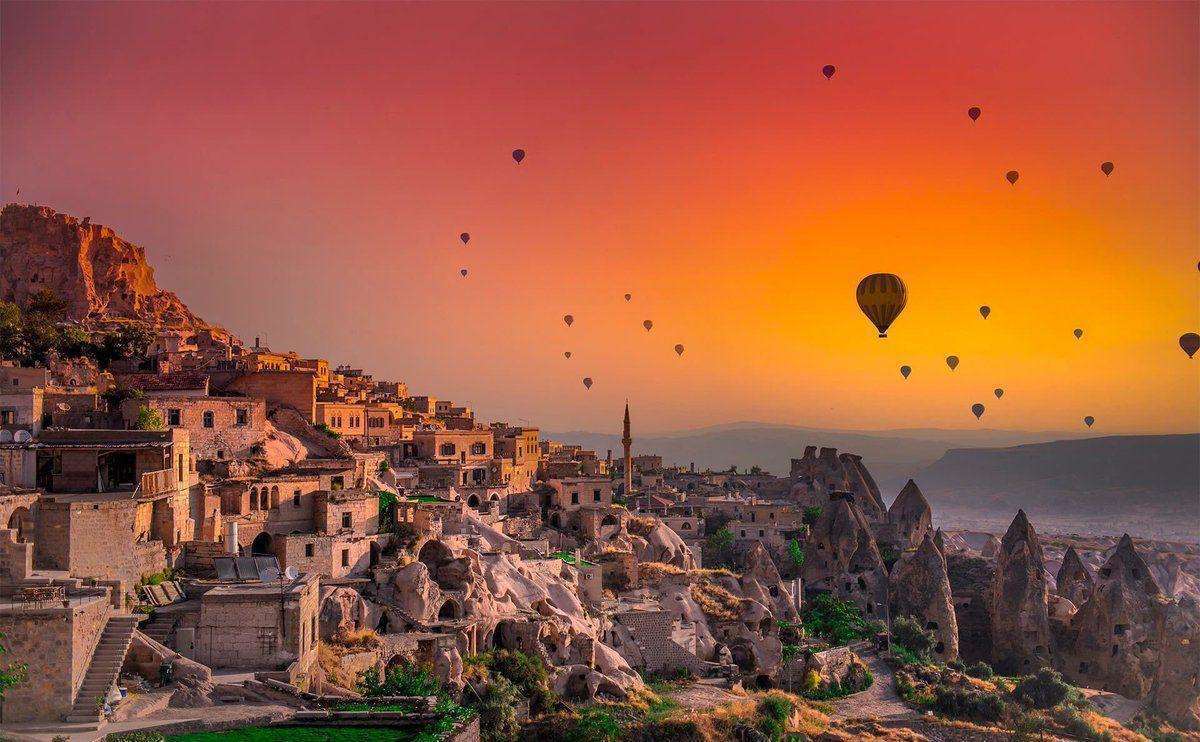
Every year a handful of our guests come back from Turkey and say the same thing: the hotel was wonderful, and they wish they had seen something. Cappadocia is the answer to that sentence. It is nothing like the coast — no sea, no resorts, a landscape of volcanic rock carved into houses and churches and a horizon that fills with balloons at dawn. Three nights there attached to a beach week is the single best upgrade you can make to a Turkish holiday.
- What it is: a region of soft volcanic rock in central Anatolia, carved into cave dwellings, churches and entire underground cities.
- The balloons launch at sunrise — up to 150 of them on a clear morning, from around 2,000 feet.
- Derinkuyu and Kaymaklı are underground cities cut as deep as 85 metres, built to shelter thousands of people.
- Three nights is right. Two is rushed; four and you have seen it.
- It is not a day trip from the coast. Plan it as a separate leg, not an excursion.
Why it belongs on a beach holiday
Turkey's coast and Turkey's interior are two different countries as far as a holiday is concerned. The Antalya resorts are Mediterranean: sea, pine, heat, and a hospitality industry built to a very high standard around the beach. Cappadocia is high, dry Anatolian plateau — cold in winter, sharp light, and a landscape that looks like nowhere else on earth.
That contrast is the reason to combine them. A fortnight of all-inclusive is a lovely thing and it is also a fortnight of one note. Break it with three nights in a cave hotel and you come home with two holidays instead of one. It is also the trip that converts people from Turkey-as-a-beach-destination to Turkey-as-a-country, which after thirty years in this business is the conversion I most enjoy watching.
What the landscape actually is
Volcanic ash from ancient eruptions settled across this plateau and compacted into tuff — a rock soft enough to dig with hand tools, hard enough to hold a roof. For thousands of years people have simply carved into it: houses, stables, storerooms, chapels, dovecotes, and in some places entire settlements running downwards rather than upwards.
Erosion did the rest. Where a harder cap of basalt sat on top of the softer tuff, the surrounding rock wore away and left columns with a stone hat on them — the fairy chimneys the region is known for. Some of them have doors and windows cut into them, because a fairy chimney is also a perfectly good house.
The result is a landscape where the geology and the human history are the same thing, which is not true of many places.
The balloon flight
This is what most people come for, and it deserves its reputation. Flights launch at sunrise, pickup from your hotel is around an hour beforehand, and on a good morning up to a hundred and fifty balloons go up together across the valleys. You drift at a few thousand feet as the light comes over the rock, and for perhaps an hour the whole region is below you.
Three practical points nobody tells you in advance. First, flights are weather-dependent and cancellations are common in winter and in windy spells — build a spare morning into your stay rather than booking a single chance on your only full day. Second, it is genuinely cold before dawn on the plateau, in any month; take more layers than the temperature forecast suggests. Third, it is not cheap and the price has risen sharply in recent years, so budget for it as a significant line item rather than an incidental.
If you do not fly, get up anyway and walk to a viewpoint. Watching a hundred and fifty balloons rise from the ground is very nearly as good as being in one, and it costs nothing.
Göreme and the rock churches
The Göreme Open-Air Museum is the region's central site: a cluster of monastic cave churches cut into the rock, several with Byzantine frescoes still on the walls. It is compact, it is busy, and it is unmissable. Go at opening time.
The frescoes are the point. In the dark rooms, painted saints and gospel scenes survive in colours that have no business being that vivid after a millennium — the darkness that makes them hard to photograph is precisely what preserved them. Photography is restricted in the best-preserved chapel, and that restriction is the reason it is still worth seeing.
Göreme village itself, below the museum, is where most visitors stay. It is small, walkable, and completely given over to tourism, which is a fair trade for having everything within ten minutes.
The underground cities
Derinkuyu and Kaymaklı are the two you can visit easily, and they are astonishing. These are not caves that people sheltered in; they are engineered settlements running as deep as eighty-five metres through multiple levels, with ventilation shafts, wells, stables, kitchens, chapels and stone doors that could be rolled across the passages from the inside. Estimates put the capacity of the largest at up to twenty thousand people.
They were refuges — built and repeatedly reused by populations who needed to disappear underground when armies came through. Standing in a stable four levels down, with the ventilation shaft going up into darkness, gives you a very direct sense of how insecure life on this plateau was for a very long time.
A caution: the passages are low, narrow and in places require walking bent over for some distance. If anyone in your party is claustrophobic or has mobility problems, this is not the trip for them, and there is no shortcut back to the surface once you are in.
Uçhisar, the valleys and everything else
Uçhisar Castle is the highest point in the region — a vast rock outcrop honeycombed with rooms, with a view over the whole of Cappadocia from the top. Go at the end of the day for the light.
The valleys are what fills the days between the headline sites. Devrent, sometimes called Imagination Valley, is a field of eroded shapes; Paşabağ has the tallest and strangest of the fairy chimneys, several with chapels cut into them; Love Valley is the one people photograph. Rose Valley and Red Valley are the best walks, and the sunset from either is worth planning for.
Ürgüp and Avanos are the two towns worth a couple of hours. Ürgüp is the more substantial, with Ottoman-era stone houses and the better restaurants. Avanos sits on the Kızılırmak river and has been a pottery town since antiquity, using clay from the riverbed — the workshops there are genuinely working rather than performing.
Ihlara Valley, further out, is a green gorge with a stream at the bottom and rock churches cut into the sides. It is a half-day and it is the antidote if you have had enough of dry rock.
Cave hotels: worth it or a gimmick?
Worth it, with a caveat. The good cave hotels in Göreme, Ürgüp and Uçhisar are conversions of genuine rock dwellings, and sleeping in a vaulted room cut out of the hillside is a real experience rather than a themed one. The stone keeps the temperature remarkably stable — cool in August, and warmer than you would expect in winter.
The caveat is that "cave hotel" covers everything from a beautifully restored merchant's house to a windowless room with a stone-effect ceiling. Rooms genuinely cut into rock have limited natural light by definition, and some have no exterior window at all. If daylight matters to you, ask specifically about the window before booking, not about the cave.
Getting there from the coast — honestly
This is the part that needs realistic expectations, and it is where I disagree with how the trip is often sold.
Cappadocia is not a day trip from Antalya. You will see coach excursions advertised in resort lobbies that leave in the small hours and return the following night. People do them and people regret them. The distance across Anatolia is substantial and most of the trip is spent on the road.
The sensible options are two. Either fly — the region is served by its own airports, with domestic connections that usually route through a hub, so check current routings and allow for a change — or treat it as a two or three-night organised leg with transport arranged, which is what most of our guests do.
Where it fits in the trip. I recommend Cappadocia at the end rather than the beginning: arrive, do the resort week, then finish inland. It is a more interesting note to end on, and after a week of doing nothing you will have the appetite for early starts and long walks that Cappadocia demands.
Three nights. Not two, because a cancelled balloon flight then costs you the whole point of the trip, and not five, because there is not five days of it. Three nights gives you one balloon morning, one spare balloon morning, the museum, an underground city and a valley walk, without any day feeling rushed.
Where to base yourself in Cappadocia
Three villages take almost all the visitors, and the choice between them matters more than the hotel does.
Göreme is the default and the right answer for most first visits. It sits in the middle of everything, the museum is a walk away, the balloon fields are on the doorstep, and you can eat and drink without arranging transport. The trade is atmosphere: Göreme is entirely given over to tourism and makes no pretence otherwise.
Ürgüp is the grown-up alternative — a real town with Ottoman stone houses, a proper high street and the best restaurants in the region. It is ten minutes from Göreme by road, which means you need a taxi or a car for the early balloon pickup, but it feels like somewhere people live.
Uçhisar is the quiet, scenic option, clustered around the castle rock with the best views in Cappadocia from its terraces. Fewer restaurants, less to do in the evening, and the strongest sense of place of the three. Choose it if the point of the trip is the landscape rather than the logistics.
What to eat inland
Anatolian food is not coastal food, and the difference is one of the pleasures of the trip. Where the Mediterranean coast is fish, olive oil and mezes, the plateau is slow-cooked meat, pulses and bread.
- Testi kebabı — the regional dish, meat and vegetables sealed in a clay pot, cooked slowly and cracked open at the table. It is theatrical and it is genuinely good; order it a few hours ahead where restaurants ask you to.
- Mantı — tiny lamb dumplings under garlic yoghurt and chilli butter. Central Anatolia does this better than anywhere.
- Local wine — Cappadocia has been a wine region since antiquity and the volcanic soil produces distinctive whites from indigenous grapes. Most restaurants pour them; almost no visitor expects them.
- Apricots, walnuts and pekmez — the plateau's produce, and a completely different set of flavours from the citrus and pomegranate of the coast.
Building the trip: which coast to pair it with
Any Turkish resort area combines with Cappadocia, but some make the logistics easier than others.
The Antalya resort region is the most common starting point simply because that is where most British flights land and where most of our hotels are. If you are basing the beach half in the Belek resorts or the Lara beach strip, you are already at the right airport for the onward leg, and finishing the holiday inland works cleanly.
From the Aegean side — the Bodrum peninsula hotels or the Kuşadası holiday area — the routing is longer, and I would weigh Cappadocia against Ephesus, which is on your doorstep there and is the other genuinely world-class site in Turkey. Doing both in one fortnight is possible but it turns a holiday into an itinerary.
If you would rather keep the whole trip on the coast, my guide to the quiet Antalya coast covers the ancient sites and empty bays within reach of a resort week, without the internal flight.
When to go
| Period | What it is like | Balloon reliability |
|---|---|---|
| April – May | Green, wildflowers, cool mornings | Good |
| June – August | Hot and dry by day, cold at dawn, busiest | Very good |
| September – October | The best combination of light, temperature and crowds | Very good |
| November – March | Cold, often snow, dramatic and quiet | Less reliable — more cancellations |
September and October are the strongest months, which is convenient: they are also the best time for the coast, so a combined trip in that window gets you both at their best. If you are planning the beach half of the holiday around the same dates, my guide to all-inclusive Turkey holidays covers the seasonal picture on the Mediterranean side.
Practical notes
- Take real shoes. Every site here involves uneven rock, loose gravel or steps cut into stone. Resort sandals will not do.
- Layers, always. The plateau sits high, and the difference between a pre-dawn balloon field and a two o'clock valley walk is enormous in any season.
- Book the balloon before you arrive. Capacity is fixed by licence and it sells out, particularly in September and October.
- Two nights minimum for the flight. One morning is a coin toss; two gives you a genuine chance.
- Carry water on the valley walks. There is very little shade and almost nowhere to buy anything once you are between villages.
Frequently asked questions
Can you visit Cappadocia as a day trip from Antalya?
You will see it sold that way in resort lobbies, and I would advise against it. The distance across central Anatolia is substantial and a day-trip version means departing in the small hours and spending most of the trip travelling. Cappadocia deserves three nights as a separate leg of the holiday, ideally at the end of a beach week rather than squeezed into the middle of one.
How much does a hot air balloon flight in Cappadocia cost?
It is a significant expense rather than an incidental one, and prices have risen sharply in recent years as demand recovered. Treat it as a major line item in the trip budget. Book before you arrive, because capacity is limited by licence and the popular autumn mornings sell out well in advance.
What is the best time of year to visit Cappadocia?
September and October, closely followed by April and May. Autumn gives you the best combination of comfortable daytime temperatures, good light and reliable balloon conditions — and it coincides with the best months on the Turkish coast, which makes a combined trip straightforward. Winter is beautiful and often snowy but balloon cancellations are far more common.
How many days do you need in Cappadocia?
Three nights. Two is a gamble, because a weather cancellation on your only balloon morning removes the main reason most people come. Three gives you a spare morning plus enough time for the Göreme rock churches, an underground city and a valley walk without rushing. Beyond four nights you will have seen the region.
Are the underground cities suitable for children?
Older children usually enjoy them enormously. The passages are low and narrow in places and require walking bent over for stretches, with no quick route back to the surface once you are several levels down. Anyone claustrophobic or with mobility difficulties should skip them, and small children may find the tighter sections frightening.
Is a cave hotel actually comfortable?
The good ones are, and the stone keeps the temperature notably stable — cool in August and warmer than expected in winter. The caveat is natural light: rooms genuinely cut into rock have limited windows by definition and some have none at all. Ask about the window specifically rather than the cave, because the label covers a wide range of conversions.
Is Cappadocia worth it if you have already booked a beach holiday?
In my experience it is the single best addition you can make. The coast and the Anatolian plateau are completely different in landscape, climate and history, so the two halves do not compete with each other. Guests who add three nights inland come home describing it as two holidays rather than one, and it is the trip people most often thank me for suggesting.
Official guidance and sources
Balloon operations are licensed and weather-dependent, and domestic flight routings within Turkey vary by season. Confirm both close to your travel dates rather than at the time of booking.
- UNESCO World Heritage Centre — Göreme National Park and the Rock Sites of Cappadocia
- UK Government — Turkey safety and security advice
- GoToBeach editorial team · 22-point hand-picked inspection methodology
- Caria Holidays Ltd · ATOL 11211 · Package Travel Regulations registered
Related reading from our specialists
- Where to stay in Turkey — all nine resort areas compared
- My hand-picked fifteen all-inclusive hotels in Antalya
- Browse every hand-picked Antalya hotel
- Browse every hand-picked Turkey holiday
Beach week plus three nights inland?
Tell me your dates and I will build the combination — the resort half on the coast, the Cappadocia leg at the end, with the connection sorted between them.