
Marrakech Area

Discover Marrakech Area

Why Book Your Marrakech Area Holiday with GotoBeach?

The Marrakech area is Morocco at its most intoxicating — and I'll be straight with you from the first line, because it saves disappointment later: this is an inland imperial city, not a beach. What it offers instead is arguably richer. A walled medina a thousand years old, the roar and theatre of the Jemaa el-Fna square at dusk, souks that swallow an afternoon, hidden riads with plunge pools behind studded doors, and the snow-capped High Atlas rising on the horizon within an hour's drive. Ringing the old city, the palm groves of the Palmeraie and the modern edge hold the big resort hotels with their gardens, spas and aqua parks. If you want culture, warmth, colour and a pool rather than a sea to swim in, the Marrakech area is one of the great short-haul escapes from the UK.

Every Marrakech-area holiday we sell is one financially protected booking — flights, transfers and hotel together under ATOL licence #11211 — and your ATOL Certificate arrives the moment you confirm, so you can see exactly how your holiday is financially protected before you part with a penny. And every hotel we put on this page has been inspected in person against our criteria, which in Marrakech matters more than most places, because a riad and a Palmeraie resort a few miles apart deliver two utterly different holidays, and a photograph tells you nothing about which one is yours.

I am Thomas Kaplan, Product Manager and Mediterranean specialist at GoToBeach, and I've spent twenty-eight years in European and North African travel — much of it with TUI and Thomas Cook before I came here to build the range I actually believe in. On my inspection trips to Marrakech I don't tour the suite the hotel wants to show me; I walk the standard rooms, the ones you'll actually be given, and I sit in the courtyard at four in the afternoon when the light goes gold and the call to prayer rolls across the rooftops, because that is when you learn whether a place has soul or just a good photographer. The question I carry into every property is the plain one: would I send my own family here, at this price, for this week? If the answer is no, it doesn't go on the page. You can read more about how I inspect these hotels before you book.
 

Photos of Marrakech Area

Hand Picked Deals

Top Hotels in Marrakech Area

Valeria Dar Atlas Resort

Marrakech / Morocco

All Inclusive

£ 1192.89

Pickalbatros Aqua Fun Club Resort

Marrakech / Morocco

All Inclusive

£ 1328.62

Movenpick Hotel Mansour Eddahbi

Marrakech / Morocco

Bed&Breakfast

£ 1839.69

Discover Marrakech Area

The resorts of the Marrakech area

Inspected in person · product-manager's verdict

The Marrakech area isn't a coast dotted with beach towns; it's one great city with a landscape of day-trip country wrapped around it. Marrakech itself is the base we book, and the one with its own landing page below. The mountains, the ocean at Essaouira and the walled town of Taroudant are characters in the story rather than resorts you'd fly to — but knowing what each is for helps you decide whether to stay put in the medina or pair the city with something else.

The imperial city · the base

Marrakech

Culture & Riads
★★★★★

The Red City and the reason most people come to Morocco: the medina and souks, the Jemaa el-Fna, the palaces and gardens, and a choice of stay that runs from a courtyard riad to a full-service Palmeraie resort with pools and a spa. Best for culture-lovers, couples and families who want warmth, colour and a pool day between sightseeing; not the pick if your heart is set on swimming in the sea — for that you want Agadir or Essaouira.

🏝 No sea — medina, pools & Atlas day trips

Around the city sit the great day-trips, worth knowing even though they're excursions rather than booking pages here. The Ourika Valley and the High Atlas begin barely an hour south of the medina — a green river gorge of Berber villages, waterfalls and terraced fields climbing to snow-dusted peaks, and our first suggestion for anyone who wants a day of cool air and mountain views after the heat of the souks. Essaouira, about two and a half hours west, is the coast Marrakech doesn't have: a whitewashed, blue-shuttered fishing port with a windswept Atlantic beach, ramparts, an easy artistic charm and some of the best grilled fish in the country — a classic day out or an overnight, and the natural place to actually feel sand and sea. And Taroudant, further south towards the Souss valley, is often called ‘little Marrakech’ — a smaller walled town with its own ochre ramparts and a gentler, less touristy rhythm, for travellers who've done the big city and want the quieter cousin.

To see how it all fits together, you can browse our full choice of Morocco holidays, weigh the city against the coast on our Agadir area page, or read the whole country at a glance in our specialist's guide to the best Morocco holidays. It all comes under one straightforward GoToBeach Morocco package.

Discover the Marrakech area

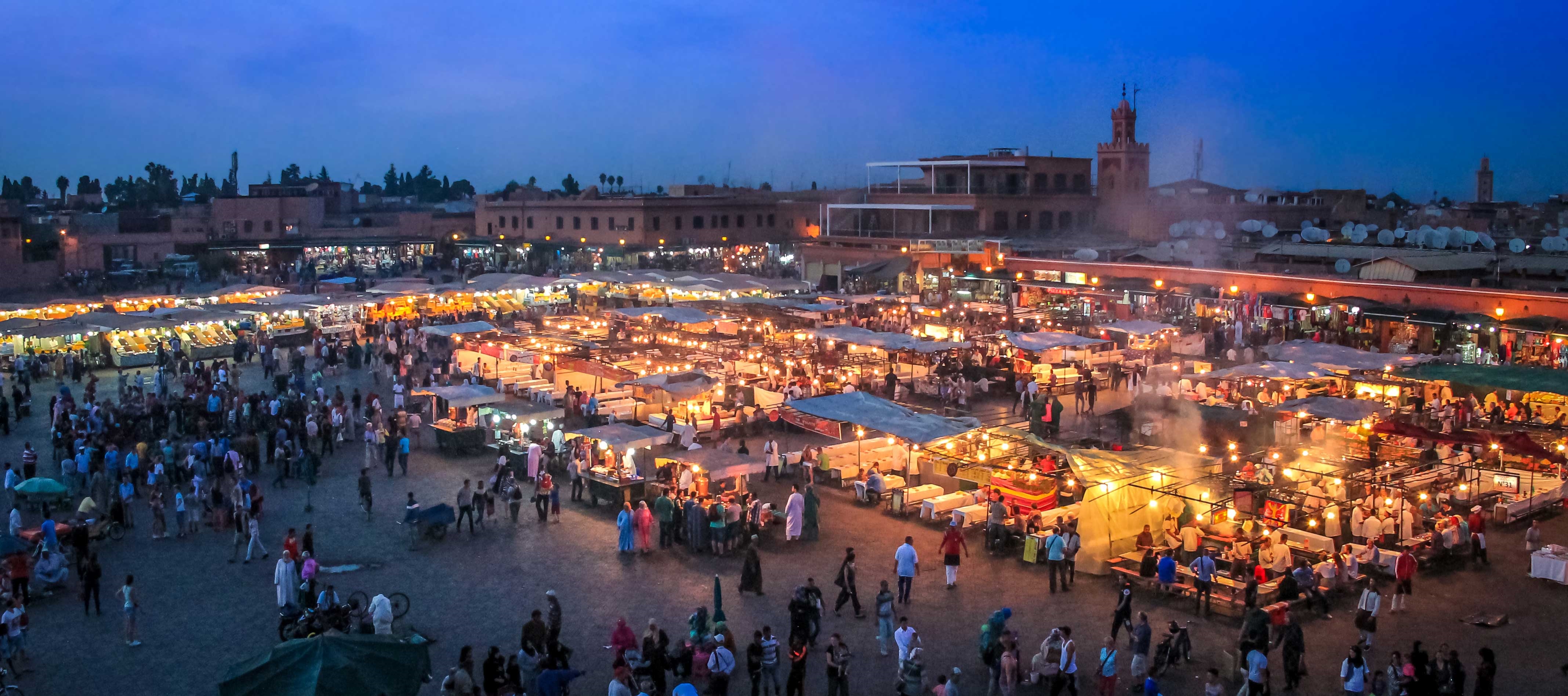
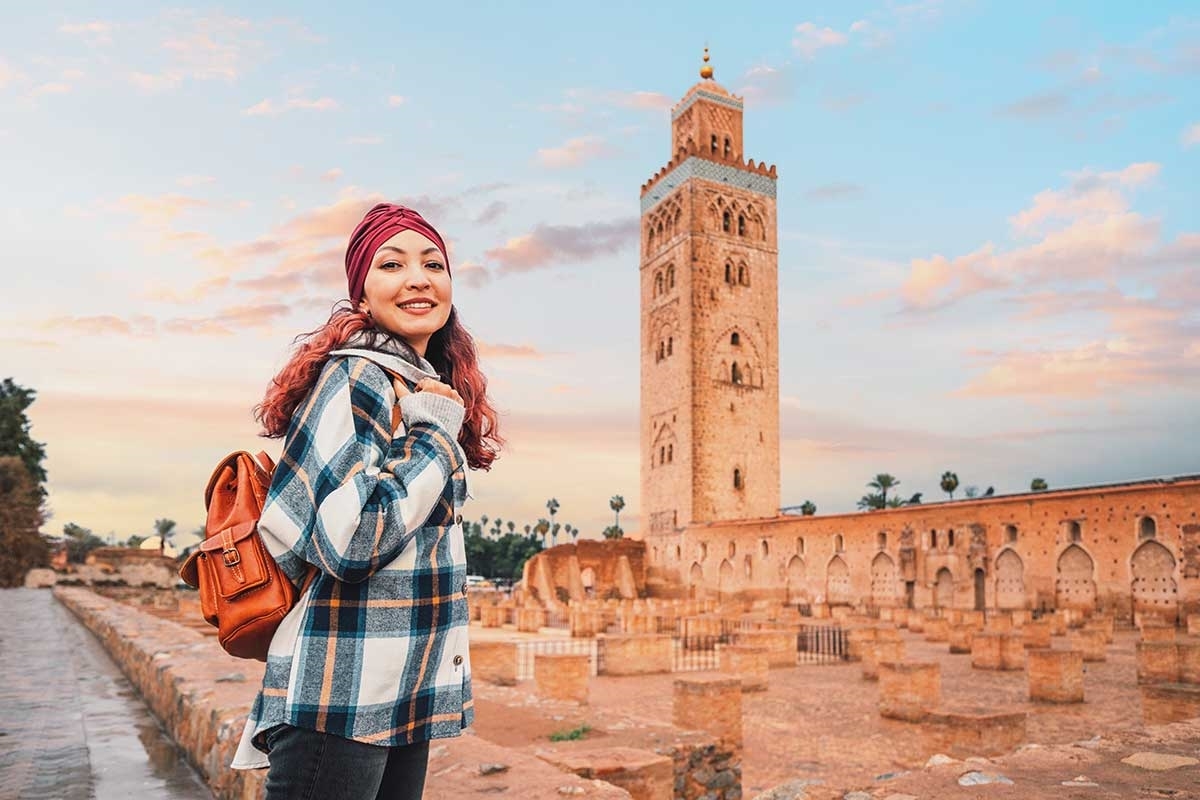
Marrakech was founded almost a thousand years ago as a Berber empire's capital, and it has never quite stopped being a crossroads — a caravan city where the Sahara, the Atlas and the Atlantic all sent their traders. That history is the whole point of a holiday here. The medina, a UNESCO-listed maze inside pink ramparts, still works as it always has: the souks graded trade by trade, from the coppersmiths' clatter to the dyers' hanging skeins, the tanneries, the spice pyramids, and at the heart of it the Jemaa el-Fna, a square that by day is orange-juice carts and snake charmers and by night becomes the largest open-air kitchen in Africa. You do not come to the Marrakech area to switch off by a pool for a fortnight; you come to be immersed, and then retreat behind a thick riad wall when you've had your fill.

The geography is the other half of the appeal, and it's why so many people pair the city with a trip out. To the south the High Atlas wall rises fast — within ninety minutes you can be in the Ourika Valley or over the Tizi n'Tichka pass towards the mud-brick kasbah of Ait Ben Haddou, standing in cool mountain air with snow on the peaks even as Marrakech bakes below. To the west lies the Atlantic and Essaouira; to the deep south, the palm oases and the first dunes of the desert. The city itself splits neatly in two for visitors: the old medina, where the riads and the sightseeing are, and the Ville Nouvelle — chiefly the Gueliz and Hivernage districts and the palm-shaded Palmeraie — where the French laid out wide boulevards and where most of the big resort hotels, gardens and golf now sit. Knowing which half you're sleeping in is the single most useful thing to settle before you book.

Marrakech area landscape, pools & the mountains

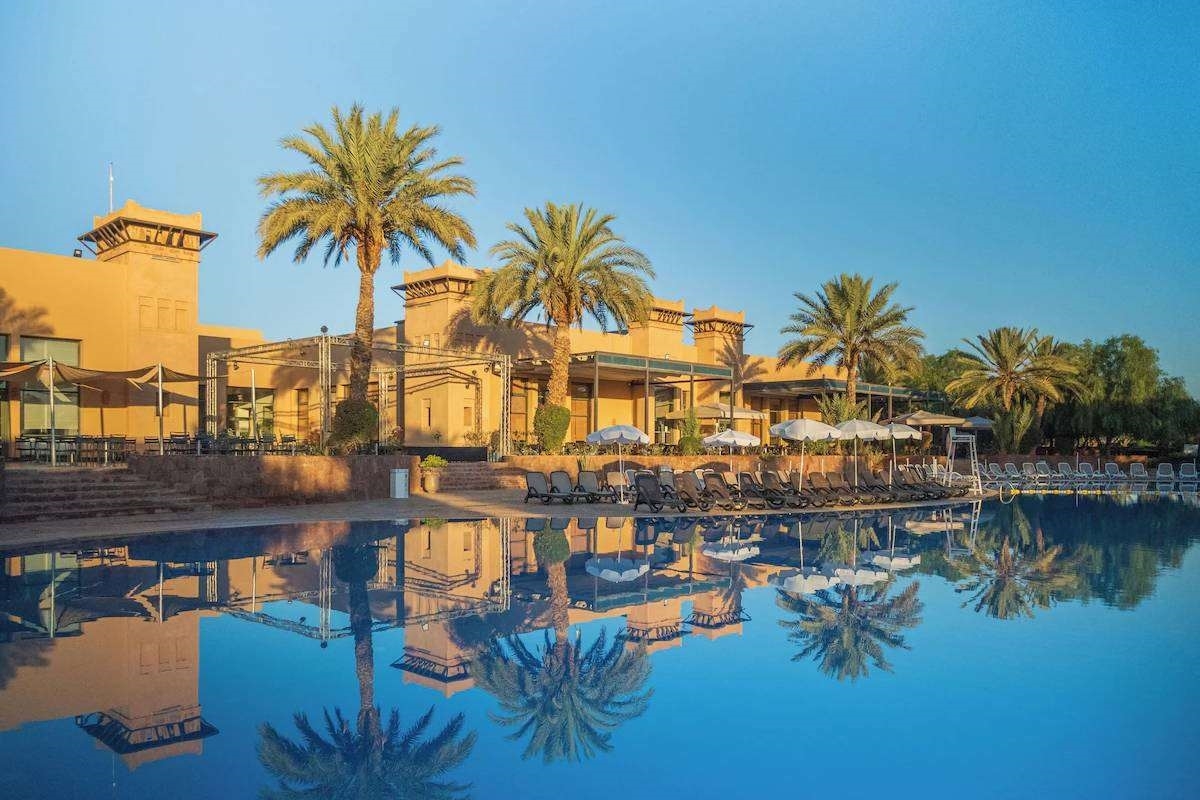
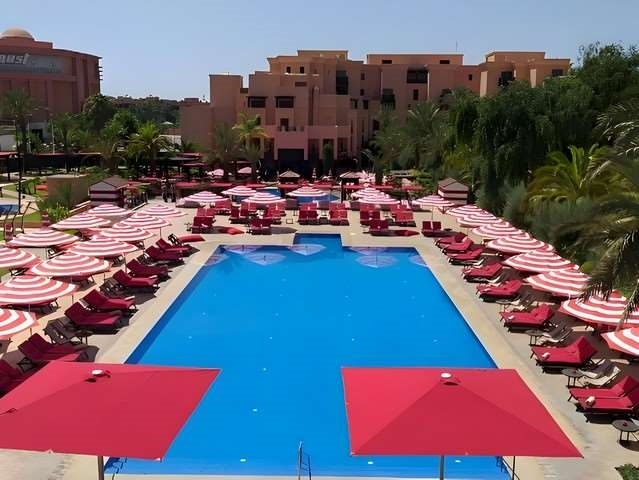
Let's settle the water question honestly, because it's the one people get wrong. There is no sea in the Marrakech area — the nearest coast is Essaouira, a two-and-a-half-hour drive away. Swimming here means a pool, and the good news is that the pool is central to how a Marrakech holiday works. In summer, when the city can push past 40°C, the middle of the day belongs to the water: a riad's cool courtyard plunge pool, or the broad landscaped pools of a Palmeraie resort, with sightseeing kept to the softer light of early morning and evening. When you book, the size and shade of the pool is not a detail — it's structural, and it's one of the first things we check on an inspection.

The landscape beyond the pool is the compensation for having no beach, and it's a generous one. The High Atlas gives you a genuine change of climate within an hour: the Ourika Valley's river pools and waterfalls, the Berber market at Setti Fatma, and higher up the walking country around Imlil beneath Mount Toubkal, North Africa's highest peak. Further out, the road over the mountains drops into the pre-Sahara — the film-set kasbah of Ait Ben Haddou, the Draa palm groves, and for those with an overnight to spare, a camel and a night in a desert camp under a sky you'll not forget. None of this involves the sea, and yet a well-planned Marrakech week rarely feels the poorer for it. Our steer is simple: build the holiday around the city and the pool, then pick one big day in the mountains and, if you can, one on the coast at Essaouira — and you'll have seen the range of this whole region without ever needing a beach towel.

Things to do around the Marrakech area

The city alone fills days. Lose a morning in the souks; visit the Bahia Palace and the Saadian Tombs; find calm in the Majorelle Garden with its cobalt-blue villa and the adjoining Yves Saint Laurent museum; wander the Ben Youssef Madrasa's tiled courtyards; and stand in the great square of the Jemaa el-Fna as the food stalls fire up at dusk. A hammam and a mint tea on a rooftop are the proper full stops to a day of walking. For families, the pull is the resorts' pools and aqua parks in the Palmeraie, with a camel ride at the palm groves and a horse-and-carriage caleche loop of the ramparts to break up the sightseeing.

Beyond the walls, the day-trips are the region's showpiece. The Ourika Valley for river and mountain air; the Agafay Desert — a stony, lunar-looking expanse barely forty minutes out — for a sunset camel ride and a Berber dinner without the long haul to the real Sahara; Ait Ben Haddou and Ouarzazate for the kasbahs and film studios over the Atlas; and Essaouira for the coast. Most run as organised day-trips with a driver, which in this terrain is much preferable to a self-drive hire, at least for the mountain roads.

The High Atlas & Ourika Valley day trips

If Marrakech is the fire, the mountains are the cool draught beside it, and the beauty of the Marrakech area is how quickly you reach them. The Ourika Valley is the easy classic: an hour or so south of the city, a green river gorge climbing between Berber villages, with roadside cafes on stilts over the water, argan-oil cooperatives, and a walk up to the seven waterfalls at Setti Fatma. On a hot day it's the perfect antidote — ten degrees cooler, running water, and lunch of tagine and fresh bread with your feet almost in the river.

Push higher or further and the trips get grander. Imlil, at the foot of Toubkal, is the trailhead for serious walkers and a lovely half-day even if you only stroll to a Berber house for mint tea. The Tizi n'Tichka road climbs over the main Atlas ridge towards Ait Ben Haddou, the honey-coloured kasbah you'll recognise from a dozen films, and Ouarzazate beyond it — a long but unforgettable day. Closer to home, the Agafay Desert gives you the drama of open, empty country and a camel at sunset within forty minutes, no dunes required. Our advice for all of these is the same: go with a reputable driver-guide rather than a hired car, carry a warm layer even in summer because the tops are genuinely cold, and treat the mountains as the counterweight that stops a Marrakech holiday becoming all souk and no sky.

Essaouira: the windswept coast two hours west

When guests tell us they've fallen for Marrakech but wish it had a beach, we send them to Essaouira. Two and a half hours west by good road, it's the Atlantic port that gives the Marrakech area its sea: a compact, walled town of whitewashed houses and blue shutters, a working fishing harbour piled with the morning's catch, wide ramparts to walk, and a long sweep of sandy beach behind them. The mood is entirely different from the city — slower, breezier, more bohemian, with art galleries, easy seafood grills on the port, and none of the medina's relentless hustle.

The honest caveat is the wind. Essaouira is famously breezy — which is why it's a kitesurfing and windsurfing capital, and why its beach is more about long walks, camel and horse rides along the sand and lunch out of the gusts than about lying still on a sunbed. The Atlantic here is cool and lively rather than a warm Mediterranean bath. But for a day, or better a night, it's the perfect counterpoint to Marrakech: you get the sea and the sand the city can't offer, a gentler pace, and some of the freshest fish in Morocco chosen straight off the ice. Plenty of guests build a twin-centre around it — a few days of medina and souk, then a couple by the ocean.

When to go to the Marrakech area

Marrakech is inland, so forget sea temperatures and think in terms of daytime heat and the sharp drop after dark. The city has two faces — glorious in spring and autumn, ferocious at the height of summer. Here's how the months feel, and when I'd book.

When Daytime After dark Our take
November–February 18–20°C 6–9°C Bright, mild winter-sun days perfect for walking the souks, but genuinely cold nights — pack a jumper and pick a hotel with heating and a warm pool if you plan to swim. A lovely, uncrowded time for culture.
March–April 23–27°C 11–14°C The sweet spot, along with autumn. Warm days, cool evenings, gardens in bloom and the Atlas still snow-capped on the skyline. My favourite window for a first visit.
May–June 28–34°C 15–18°C Hotting up fast but still very doable, with long light evenings. Sightseeing early and late, pool in the middle of the day, and good value before the peak.
July–August 37–40°C+ 20–23°C Fierce, dry desert heat — the middle of the day belongs to the pool and the shade, full stop. Fine if you plan around it and want a bargain, hard going with small children unless the hotel is built for it.
September–October 28–32°C 15–18°C The other sweet spot: summer's heat easing, warm days, comfortable evenings and thinner crowds. An excellent all-round time to combine city and mountains.

For a first Marrakech trip, aim squarely at spring or autumn — March to May, or late September into November — when the city is warm rather than punishing and the mountains are at their best. Winter suits culture-first travellers who don't mind wrapping up after dark, and high summer is for the heat-hardy and the budget-minded who'll treat the pool as headquarters. If you want the sea to be reliably warm, remember that's Agadir's job, not Marrakech's.

The practical parts

Getting there

You fly into Marrakech Menara (RAK), around three and a half hours direct from the UK, with wide year-round choice. Morocco is on GMT in winter (same as the UK) and one hour ahead in summer, so there's no jet lag to speak of. The airport sits just a few miles from the medina and the Palmeraie, so most transfers are 15–25 minutes. Your transfer is included in every GoToBeach package — useful in a medina where taxis can't reach the riad door.

Passports & entry

UK citizens can visit Morocco for up to 90 days without a visa — you simply get an entry stamp at the border. Your passport should be valid for the duration of your stay; we'd recommend at least six months to be safe, undamaged, with a blank page for the stamp. Entry rules can change at short notice, so always check the official FCDO guidance, linked below, before you travel.

Money

The currency is the Moroccan dirham (MAD), and it's a closed currency — you can't buy it in the UK, so change money or draw from an ATM once you arrive. Cards work in hotels, larger restaurants and smart shops, but the souk, the taxis and the tips run on cash, so keep small notes handy. Haggling in the market is expected and good-humoured, and small tips for guides, drivers and porters are customary and appreciated.

Health & insurance

No vaccinations are compulsory for a normal visit, though it's worth checking the NHS Fit for Travel advice, linked below. Drink bottled rather than tap water, be sensible with salads and street food in the heat, and pack serious sun protection — Marrakech tops 40°C in summer and the sun is fierce. Private medical care must be paid for up front, so comprehensive travel insurance is essential; we can help you arrange suitable travel insurance.

Getting around

The medina is walkable — and much of it car-free, so you'll finish the last stretch to a riad on foot with a porter for the bags. Petit taxis are cheap for hops across the new city; agree the fare or insist on the meter before you set off. Morocco drives on the right. For the Atlas, Ourika, the Agafay Desert or Essaouira, take an organised day-trip with a driver rather than self-driving the mountain roads. We can pre-book your airport transfers so you arrive to a name-board, not a negotiation.

Food & drink

This is one of the world's great food cities. Tagines and Friday couscous, pastilla, harira soup, brochettes off the Jemaa el-Fna grills, and endless glasses of sweet mint tea — eat where the queue is local. Morocco is a Muslim country, so alcohol is served in hotels and licensed restaurants rather than everywhere; menus are usually in French and English. For where to book a table, our guide to where to eat in Marrakech is the shortcut to the good ones.

Map of Marrakech Area

Frequently Asked Questions About Marrakech Area

Common questions and answers for planning your Marrakech Area holiday.

Handpicked packages featuring the best destinations across the Marrakech Area

Official guidance & sources

Entry and health rules for Morocco can change at short notice, so always check the official advice when you book and again shortly before you fly. These are the sources we trust.