

Malta Holidays: The Complete 2026 Guide
Twenty-seven kilometres long, three thousand years of history, and almost no sandy beaches. Here is how to plan it.
By Thomas Kaplan · Product Manager · Last updated: August 2026
Malta is the destination I most often have to reframe for British holidaymakers before they book. People arrive at the idea expecting a Mediterranean beach island and find something rather more interesting: twenty-seven kilometres of limestone with three thousand years of layered history on it, English spoken everywhere, a capital that is a UNESCO site, and — this is the part that needs saying early — almost no sandy beaches. Get your expectations aligned and it is one of the most rewarding weeks in the Mediterranean.
- Malta is small — roughly 27 km by 14 km — so where you stay matters more than how far you will travel.
- The beaches are mostly rock and platform, not sand. Mellieħa and the north hold most of the sand there is.
- English is an official language, which makes it unusually easy for British travellers.
- All-inclusive exists but is scarce and works differently from Turkey — see the note below.
- The season runs long. Malta is genuinely pleasant from April to early November.
What Malta actually is
An archipelago south of Sicily, of which three islands matter to a holidaymaker: Malta itself, Gozo, and tiny Comino between them. The whole of Malta is about the size of the Isle of Wight, which has two consequences worth understanding before you book.
The first is that nothing is far. You can be at the other end of the island in forty minutes, which means a poor choice of base is recoverable in a way it would not be in Turkey or Greece.
The second is that the areas are much more different from each other than their proximity suggests. St Julian's is nothing like Mellieħa. Sliema is nothing like Gozo. On an island this small that seems improbable until you spend a week here, and it is the single most important thing to get right.
The other defining fact is history. Malta has been Phoenician, Roman, Arab, Norman, ruled by the Knights of St John for two and a half centuries, French briefly, and British for over 150 years until 1964. All of it is still visible, and the British layer is why the plug sockets, the driving side and the language will all feel oddly familiar.
The seven areas, and who each suits
| Area | Character | Best for | Beach |
|---|---|---|---|
| St Julian's | The island's energy centre, and Paceville nightlife | Nightlife, dining, big-brand hotels | Rock and platform |
| Sliema | Cosmopolitan seafront promenade and shopping | Walking, restaurants, ferry to Valletta | Rock platforms and lidos |
| St Paul's Bay & Qawra | Lively but less intense than Paceville | All-inclusive, value, families | Rock, some small sand |
| Mellieħa | Quiet village on a hill above the north coast | Sand, families, calm | Malta's best sandy beaches |
| Gżira | Between Sliema and Valletta, harbour-facing | Value with a central position | Rock, harbour front |
| Floriana | On Valletta's doorstep, above Grand Harbour | Culture, city breaks | None — this is a city base |
| Gozo | A slower, greener, more rural island | Escaping, walking, second weeks | Red sand at Ramla, rocky elsewhere |
My full head-to-head of the four main resort areas is in my honest Malta area guide, and the shorter decision version is where to stay in Malta.
The beach conversation, honestly
This is where I earn my living, because it is the single biggest cause of disappointment on this island and it is entirely preventable.
Malta's coast is predominantly limestone. What that means in practice is that most swimming is from rock platforms, lidos and ladders into deep, extraordinarily clear water — which is wonderful, and is not what most British families picture when they book a Mediterranean holiday.
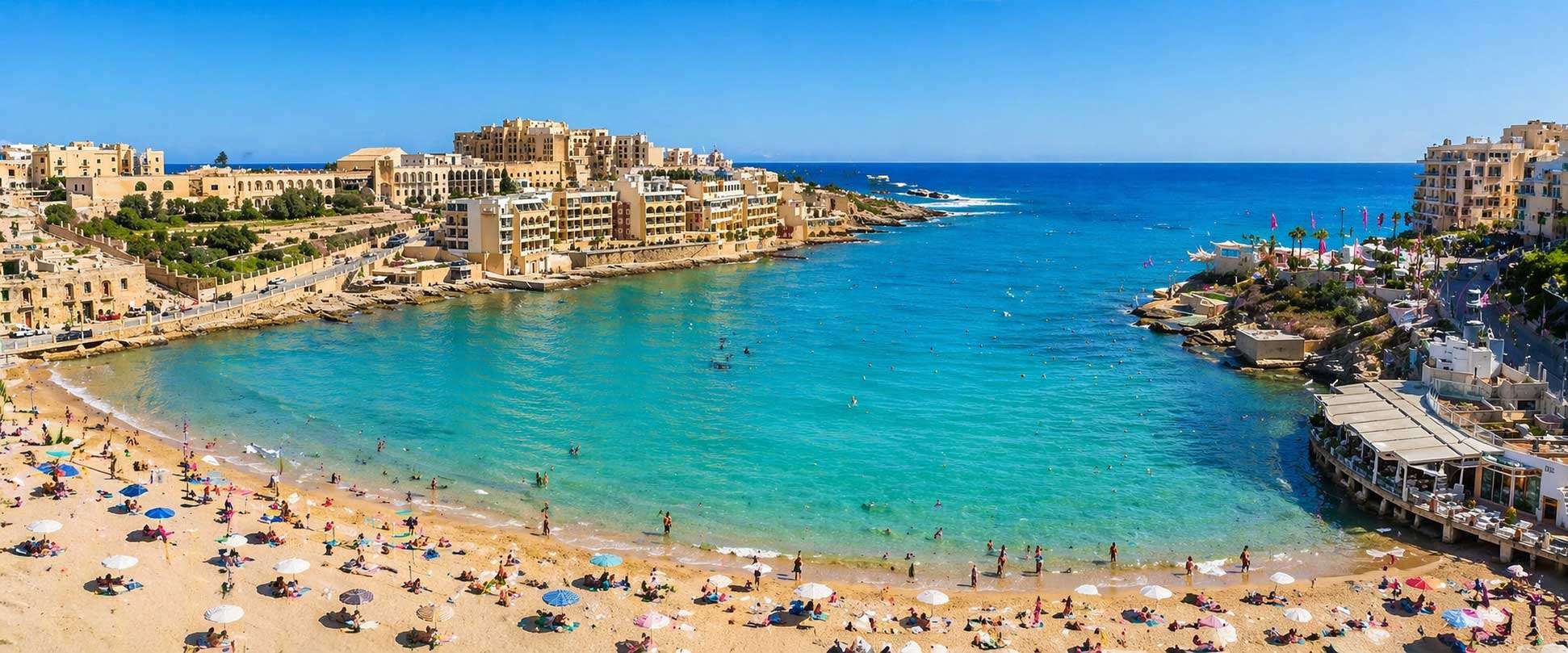
Sand does exist. Mellieħa Bay in the north is the largest sandy beach on the island, and the north-west holds most of the rest. Gozo has red sand at Ramla. But if a wide sandy beach directly in front of your hotel is central to the holiday, Malta is the wrong island and I would rather tell you that now than have you find out on day one.
What Malta offers instead is water clarity that the sandy destinations cannot match, and the reason is the same limestone: nothing is being stirred up. For swimmers and snorkellers it is a straight upgrade. My guide to the best beaches in Malta sets out where the sand actually is.
Valletta and the history
The capital is a UNESCO World Heritage Site and one of the most concentrated historic cities in Europe — built by the Knights of St John after the Great Siege of 1565, laid out on a grid across a peninsula between two harbours, and almost entirely intact.
You can walk across it in twenty minutes and spend three days doing so. St John's Co-Cathedral holds two Caravaggios and an interior that is difficult to describe without sounding hyperbolic. The Upper Barrakka Gardens give you the Grand Harbour view that appears on every photograph of Malta. The Saluting Battery still fires at noon.
Accommodation inside Valletta itself is boutique and small-scale — intimate rather than resort-like. Most visitors stay elsewhere and come in for a day or an evening, which works perfectly well on an island this size. The hotels in Floriana, immediately outside the city walls, are the practical base if you want the capital on your doorstep.
Gozo, and whether to bother
Yes, bother. Gozo is a twenty-five minute ferry from the northern tip of Malta and it is a genuinely different place: greener, slower, more rural, and built around villages rather than resorts. The Citadel above Victoria is the landmark; Ramla Bay has the red sand; and the diving is the best in the archipelago.
How to use it depends on your week. A day trip works and most people do that. But staying on Gozo for two or three nights at the end of a Malta week gives you a completely different holiday from the one you have just had, and it is the single suggestion our returning Malta guests most often thank us for. My full guide to holidays on Gozo covers it properly.
Getting there and getting around
Flights. Malta International is a three to three and a half hour flight from most UK airports, and the island is served year-round rather than seasonally — one of the few Mediterranean destinations where that is true. The airport sits in the middle of the island, so no transfer anywhere on Malta takes long: twenty minutes to Sliema or St Julian's, around forty to Mellieħa.
Buses. The public network is comprehensive, inexpensive and slow, radiating from a hub at Valletta. For a week of moving between two or three areas it works perfectly well. For getting to a specific beach at a specific time in August, it is a test of patience.
Taxis and ride apps operate across the island and are the pragmatic choice for evenings out, particularly from Mellieħa where the bus back is a long affair.
Hire cars. Worth it if you are staying in the north or on Gozo and want to explore properly. Two things to know: the roads are narrower and busier than the map suggests, and Maltese driving is noticeably more assertive than British driving. The left-hand side is at least familiar.
The Gozo ferry runs frequently from Ċirkewwa at the northern tip, takes around twenty-five minutes, and carries cars. The crossing itself is one of the nicer half-hours of a Malta holiday.
What a week actually looks like
Because the island is small, a Malta week has a different shape from a resort holiday. Here is the pattern that works for most of our guests.
Two days doing nothing. Pool, lido, the rock platforms, a long lunch. This is the holiday part, and Malta's water is the reason to spend it swimming rather than sunbathing.
One day in Valletta. The cathedral, the Upper Barrakka, the harbour, dinner in the city. It deserves a full day rather than a morning.
One day on Gozo, or two or three nights if you have the time. The ferry, the Citadel, Ramla Bay, and a considerably slower pace.
One day on the water. A boat to Comino and the Blue Lagoon, or a dive if you are qualified. This is what the limestone coast is genuinely best at.
One day of your own choosing. The megalithic temples, Mdina's silent walled streets, the Three Cities across the Grand Harbour, or simply the beach at Mellieħa if you have found the sand and want to stay on it.
That leaves an evening or two for St Julian's if nightlife is on the agenda, and it is why so many guests end up wishing they had booked ten nights rather than seven.
All-inclusive in Malta: manage your expectations
Malta does all-inclusive differently from Turkey and Egypt, and the gap is wide. The properties are smaller, the food and drink offer is narrower, entertainment is lighter, and many all-inclusive hotels are in town locations rather than self-contained resorts. All-inclusive here works best as a meal safety net for a Malta-led holiday, not as a stay-at-the-resort-all-day experience. I have set out exactly what is and is not included in my guide to all-inclusive Malta holidays.
The genuine all-inclusive properties are concentrated in Mellieħa and St Paul's Bay, and there are not many of them — db Seabank Resort & Spa, db San Antonio Hotel & Spa, Qawra Palace Resort & Spa and Ramla Bay Resort among them.
Half board is frequently the smarter choice here, precisely because Malta is a place you should be leaving the hotel to eat. That is the opposite of the advice I would give for Antalya, and it is a good illustration of how different the two destinations are.
When to go
| Period | What it is like | Best for |
|---|---|---|
| April – May | Warm, green, wildflowers, sea still cool early on | Walking, history, Gozo, lower prices |
| June | Reliably hot, sea warming, before the peak | The best all-round month |
| July – August | Very hot, very busy, everything open late | Nightlife, school holidays, swimming |
| September – October | Sea at its warmest, heat easing, crowds thinning | Couples, diving, value |
| November – March | Mild, quiet, some hotels closed, occasional rain | City breaks, culture, Valletta |
Malta's season runs longer than most Mediterranean destinations because the winters are mild and the capital works year-round. My month-by-month breakdown is in when to go to Malta.
Practical notes for British travellers
- English is an official language. Everybody speaks it, signage is bilingual, and there is no language friction at all.
- They drive on the left. One of the few places in Europe where a British licence-holder is immediately comfortable — though Maltese driving is more assertive than you may expect.
- The euro is the currency, and UK plugs fit the sockets. Both are legacies of the same history.
- Public transport is buses. Comprehensive, cheap and slow. Distances are short enough that this works.
- Entry requirements can change. Malta is in the Schengen area — always check the current position before you travel.
What Malta is genuinely good at
History you can walk into. The megalithic temples predate the pyramids. The Knights' architecture is everywhere. The Second World War siege history is still raw in the harbours. For a week where you want to see things rather than sit by a pool, few Mediterranean islands compete.
Diving. Clear water, wrecks, caves and Gozo's underwater topography make this one of the strongest dive destinations in the Mediterranean.
Eating out. Malta's restaurant scene has improved enormously and it is one of the reasons half board often beats all-inclusive here. My guide to Malta's nightlife and gastronomy covers where to eat in detail.
Ease. Short flight, English everywhere, familiar plugs, left-hand driving, euros. For a first independent Mediterranean trip, or for older travellers, that ease is worth a great deal.
What it is not good at
Sandy beach resorts. Covered above, and the reason most disappointments happen.
Large-scale all-inclusive. The island never developed that culture and it is not going to.
Aquaparks and mega-resorts. If you want a Turkish-style family resort with slides and eight pools, Malta cannot give you that. It gives you something else.
Absolute quiet in St Julian's. Paceville is genuinely loud until the early hours. Choose your area accordingly.
Frequently asked questions
Is Malta good for a beach holiday?
It depends what you mean by beach. Malta's coast is mostly limestone, so swimming is largely from rock platforms and lidos into exceptionally clear deep water. Sand exists — Mellieħa Bay is the largest, with more in the north-west and red sand at Ramla on Gozo — but it is limited. If a wide sandy beach in front of the hotel is essential, Turkey or Greece will serve you better.
Where should I stay in Malta?
St Julian's for nightlife, dining and the biggest hotels. Sliema for the promenade, shopping and the ferry to Valletta. St Paul's Bay and Qawra for all-inclusive and value. Mellieħa for sand and quiet. Floriana for the capital on your doorstep, and Gozo for a slower, greener second week.
How long do you need in Malta?
A week covers the island comfortably given how short the distances are. Ten nights lets you add two or three nights on Gozo, which is the arrangement I recommend most often — it gives you two quite different holidays rather than one, and returning guests consistently say it was the best part of the trip.
Is all-inclusive worth it in Malta?
Sometimes, but it works differently here. Properties are smaller, the drink and food range is narrower and entertainment is lighter than in Turkey, and many all-inclusive hotels sit in town rather than in self-contained resorts. It suits travellers who want predictable meal costs while exploring the island. Half board is often the smarter choice, because Malta rewards eating out.
Do they speak English in Malta?
Yes — English is an official language alongside Maltese, and it is spoken universally. Signage is bilingual, and there is effectively no language barrier for British visitors. Combined with left-hand driving, UK plug sockets and a familiar legal system, Malta is one of the easiest Mediterranean destinations for a first independent trip.
When is the best time to visit Malta?
June for the best all-round balance, or September and October when the sea is at its warmest and the summer crowds have gone. April and May are excellent for walking, history and Gozo, though the sea is cool early in that window. Winter is mild and quiet, and works well for a Valletta city break.
Is Gozo worth visiting?
Very much so. It is a twenty-five minute ferry from northern Malta and feels like a different country — greener, slower, built around villages rather than resorts, with the best diving in the archipelago and the red sand at Ramla Bay. A day trip works, but two or three nights there at the end of a Malta week is the arrangement guests most often thank us for suggesting.
Is Malta expensive?
It sits in the middle of the Mediterranean range — more expensive than Turkey, comparable to or slightly below mainland Spain and Greece. Eating out is good value relative to the quality, which is one reason half board often makes more sense than all-inclusive. Hotel prices peak sharply in July and August and drop noticeably either side.
Official guidance and sources
Malta is in the Schengen area and entry requirements for British passport holders can change at short notice. Confirm the current position close to your departure date, and arrange travel insurance when you book.
- UK Government — Malta entry requirements
- UK Government — Malta safety and security advice
- GoToBeach editorial team · 22-point hand-picked inspection methodology
- Caria Holidays Ltd · ATOL 11211 · Package Travel Regulations registered
Related reading from our specialists
- Where to stay in Malta — by holiday type
- Where the sand actually is on Malta
- Browse every hand-picked Malta holiday
Malta, or somewhere sandier?
Tell me what you picture when you imagine the holiday. If Malta fits, I will match you to the right area. If it does not, I will say so.